
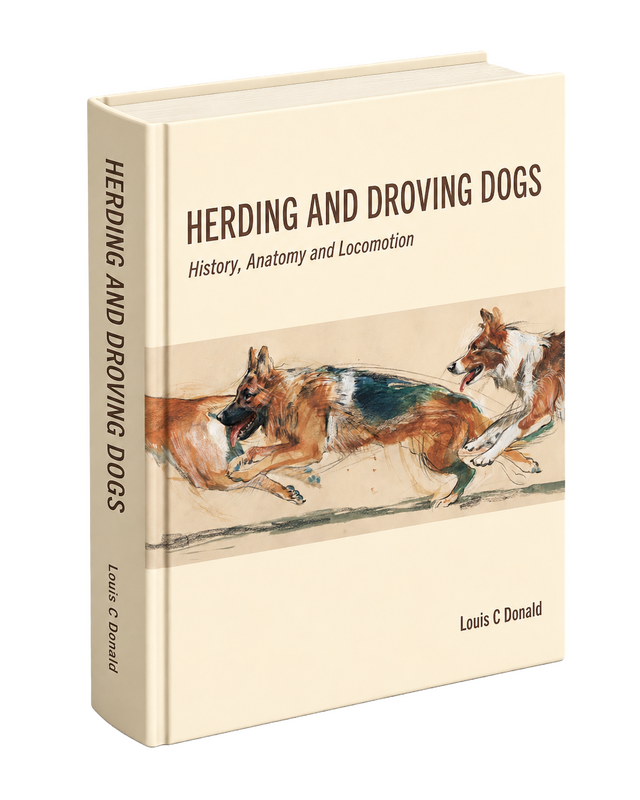
HERDING AND DROVING DOGS
History, Anatomy and Locomotion
This book examines 51 herding and droving breeds through the lens of structure, function, and work. Across these breeds, form and movement vary widely. Each was shaped in anatomy, gait, and character to meet specific tasks, from long-distance tending to close-quarters yard work and protective roles. Environments and livestock types are treated as key drivers of design, linking terrain, climate, and animal behaviour to breed construction.
The German Shepherd Dog is used as an intermediate reference model. From this base, the text maps how other breeds diverge in proportion, angulation, reach and drive, turning ability, stability, and coat.
The Anatomy and Gait chapters are extensive and cover every aspect of structure and movement. Topics include trunk proportions, forehand and hindquarter balance, shoulder and upper arm relationships, pelvic length and angle, femur and tibia ratios, pastern and foot architecture, back strength, loin elasticity, and croup shape. Clear explanations are paired with diagrams, footfall sequences, and comparative photographs to make biomechanics readable and practical.
Each breed section places construction in the context of original purpose, working style, and environmental pressures, showing how small differences in form produce distinct movement outputs. The result is a unified framework that honours breed identity while making function visible to breeders, judges, trainers, veterinarians, and serious enthusiasts.
Richly illustrated and written for clarity, the book aims to be a reliable reference for anyone evaluating herding and droving dogs, whether in the field, in the ring, or breeding.